
Homemade Cream Cheese

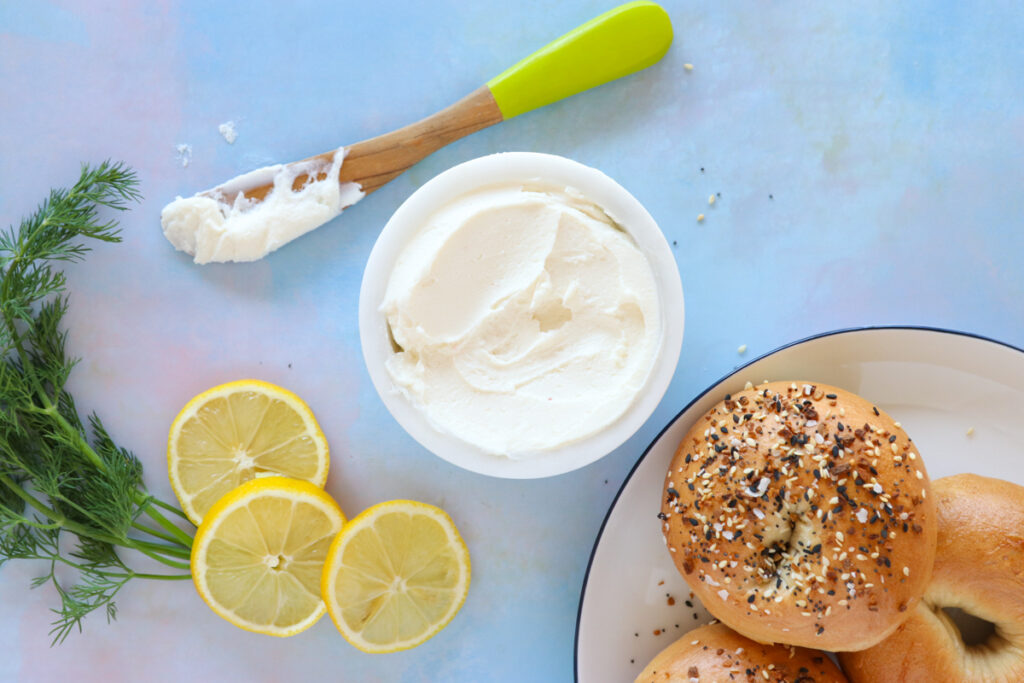
Did you know you can make your own cream cheese? It’s true, and you can have a batch ready in about 30 minutes with two main ingredients and no special equipment.

Homemade cream cheese came in handy during the great cream cheese shortage a few years back, when the East Coast had the best bagels around and nothing to put on them. A cruel twist of fate. I love a bacon egg and cheese on an everything bagel as much as the next hungover person, but a bagel with no schmear? Come on.
Good news: cream cheese is easier to make than you think. This is not the most traditional method, but it is quick, and when you need schmear, you need schmear. Have no fear, you do not have to wait for schmear. (Sorry about that.)
What is cream cheese?
Cream cheese is a soft, mild, slightly tangy fresh cheese made from milk and cream. It is not aged like cheddar or parmesan. It is a fresh cheese, meant to be eaten soon after it is made, which is part of why it is so easy to pull off at home.
The texture is what people love: thick, smooth, and spreadable straight from the fridge. It is the obvious move on a bagel, but it also turns up in cheesecake, frostings, dips, and creamy sauces.
A few traits that set cream cheese apart:
- Fresh, not aged like a hard cheese
- Soft and spreadable, even straight from the fridge
- Mild, with a gentle tang
- Rich and high in fat
- Made from cow’s milk and cream

What is cream cheese made of?
Real cream cheese is made of three things: milk and cream, an acid, and salt. That is it. The acid, usually lemon juice or vinegar, curdles the dairy and separates it into curds and whey. The curds become your cream cheese.
The cream cheese in the grocery store is a little different. Most brands add stabilizers and thickeners like carob bean gum or guar gum to extend shelf life and keep the texture uniform. There is nothing alarming about that, but homemade cream cheese skips all of it. Three ingredients, no gums.
Cream cheese vs mascarpone vs ricotta
All three are fresh cheeses, and people mix them up all the time. Here is how they differ.
Mascarpone is the richest of the three. It is an Italian cheese made from cream, with a higher fat content than cream cheese and a softer, almost whipped texture. It is sweeter and less tangy, and it is what you want in tiramisu.
Ricotta is the lightest. It is made from whey and has a loose, curdy texture rather than a smooth spreadable one. It is grainy where cream cheese is creamy.
Cream cheese sits in the middle: tangier than mascarpone, smoother than ricotta, and sturdy enough both to spread on a bagel and to hold up in a cheesecake. You can sometimes swap one for another in a pinch, but they are not identical. For a bagel you want cream cheese. For tiramisu, reach for mascarpone. For lasagna, ricotta. When a recipe leans on the texture, the three are not interchangeable.
Why make cream cheese at home?
A few good reasons to skip the foil-wrapped block:
- It is cheaper than you would guess, especially if you catch milk and cream on sale.
- No stabilizers or gums, just dairy, acid, and salt.
- It tastes fresher and a little brighter than the block kind.
- You control the salt and how thick or soft it ends up.
- It takes about 30 minutes, and most of that is hands-off.
The one catch: homemade cream cheese does not keep as long as the store kind, because it has no preservatives. That is the tradeoff for a three-ingredient label.

Ingredients you’ll need
You need just a few things, and you probably have most of them already.
- Whole milk. Full fat is not optional here. Low-fat milk will not give you enough curd.
- Heavy cream. The cream is what makes the cheese rich and spreadable instead of crumbly.
- An acid. Fresh lemon juice is my default. Distilled white vinegar works too.
- Salt, added to taste at the end.
You will also want a fine mesh strainer, a piece of cheesecloth, and a food processor or blender for the final smooth texture.
Ingredient substitutions
- No heavy cream? Use all whole milk. The result is less rich and closer to a farmer’s cheese, but still good.
- No lemon? White vinegar curdles the milk just as well, with a slightly more neutral flavor.
- Want it tangier? Stir a spoonful of buttermilk or plain yogurt into the finished cheese.
How to make homemade cream cheese
Here is the whole process, start to finish. The full recipe with measurements is in the card below.
Step 1: Heat the milk and cream
Pour the milk and cream into a pot and warm it over medium heat until it is just about to simmer, around 190°F. Stir now and then so the bottom does not scorch.
Step 2: Add the acid
Take the pot off the heat and stir in the lemon juice. Within a minute or two it will separate into soft white curds and thin, yellowish whey. If it does not curdle, add a little more acid and give it another minute.

Step 3: Strain the curds
Line a strainer with cheesecloth and set it over a bowl. Pour in the curdled milk and let it drain for about 15 minutes. The whey runs off and the curds stay behind. Do not wring it bone dry, you want to keep some moisture.
Step 4: Blend and season
Move the drained curds to a food processor, add salt, and blend until completely smooth. This is the step that turns curds into that classic spreadable texture. Taste, adjust the salt, and it is schmear time.


Tips for the best cream cheese
- Use the freshest, best dairy you can. With three ingredients, every one of them matters.
- Do not skip the cream. Milk alone makes a firmer, drier cheese.
- Heat the dairy gently. Boiling it hard can make the curds tough.
- Blend longer than you think you need to. The difference between grainy and silky is a couple of extra minutes in the food processor.
- Save the whey. That leftover liquid is great in bread dough, smoothies, or soup instead of going down the drain.
- Chill it before serving. Cream cheese firms up and the flavor settles after a few hours in the fridge.
Cream cheese flavor variations
Plain cream cheese is a blank canvas. Once you have a batch, beat in whatever you like. A few favorites:
Savory: everything bagel seasoning, chopped fresh dill, scallions, roasted garlic, or a handful of soft herbs. My dill pickle cream cheese is a whole recipe of its own.
Sweet: a swirl of honey, cinnamon and sugar, strawberry jam, or fresh lemon zest.
I have a whole post on how to make flavored cream cheese with a dozen more ideas if you want them.


How to store homemade cream cheese
Keep homemade cream cheese in an airtight container in the fridge. Because it has no preservatives, it does not last as long as the store kind, so plan on about one to two weeks.
You can freeze it, but the texture changes. Frozen and thawed cream cheese turns a little crumbly, so after that it is best in cooked or baked dishes rather than spread on a bagel. Give it a good stir or a quick blend once it thaws.
What to use cream cheese for
Once you have a batch, here is where it goes:
- On a bagel, obviously. It is the whole reason schmear exists. It is just as good on a homemade bialy.
- In cheesecake. Cream cheese is the backbone of a classic New York cheesecake, and I have a roundup of 70 cheesecake recipes to prove it.
- In dips, like a good everything bagel dip.
- In frosting for carrot cake, red velvet, and cinnamon rolls.
- Stirred into creamy pasta sauces or mashed potatoes for extra richness.
And of course, pile it on for a proper spread. Here are 20 homemade bagel recipes to schmear it on.
A brief history of cream cheese
You may be surprised to learn cream cheese was not invented by a Jew. I will give you a moment to process that.
Cream cheese is a richer spin on the French cheese Neufchâtel. In the 1870s, a dairy farmer in upstate New York, not Philadelphia, named William Lawrence partnered with a grocer to make a fuller, creamier version. A cheese broker named Alvah Reynolds, a real job, later packaged it as Philadelphia Cream Cheese, because Philadelphia was known at the time as the city for top-quality food. Smart marketing, and the name stuck even though the cheese was never from Philadelphia.
As cream cheese caught on, Breakstone’s joined the schmear game in the 1920s, and before long cream cheese was paired with the bagels and lox we know and love today. That bagel, lox, and schmear combination became a Jewish deli staple in early 20th-century New York, and cream cheese has been part of Jewish American food ever since, French origins and all.

Cream cheese FAQ
How is cream cheese made?
Cream cheese is made by heating milk and cream, adding an acid like lemon juice to curdle it, straining off the watery whey, and blending the curds with salt until smooth. At home the whole process takes about 30 minutes.
What is cream cheese made of?
Homemade cream cheese is made of just milk and cream, an acid, and salt. Store-bought versions usually add stabilizers like carob bean gum to extend shelf life.
Is homemade cream cheese cheaper than store-bought?
It can be, especially when dairy is on sale. The bigger wins are freshness and a short ingredient list rather than dramatic savings.
Why didn’t my milk curdle?
It usually needs more acid or more heat. Make sure the milk is hot, close to a simmer, and add lemon juice or vinegar a little at a time until you see curds form. Also, don’t use ultra processed milk, the milk will not curdle.
Can you freeze homemade cream cheese?
Yes, but the texture turns crumbly after thawing. Frozen cream cheese is best used in baked goods, sauces, or dips rather than spread straight on a bagel.
Is homemade cream cheese vegetarian?
Yes. This version uses lemon juice or vinegar to curdle the milk, so it is vegetarian, and it is kosher dairy.
How long does homemade cream cheese last?
Stored in an airtight container in the fridge, homemade cream cheese keeps for about one week. With no preservatives, it will not last as long as a store-bought block. If it smells sour or sharp, toss it.
Can I make cream cheese without a food processor?
You can. A blender works, or you can whisk and mash the curds by hand for a more rustic, slightly textured spread. A food processor just gets you the smoothest result with the least effort.

Homemade Cream Cheese
Ingredients
- 2 cups full-fat milk
- 2 cups heavy whipping cream
- 3 tablespoons lemon juice
- Salt to taste
Instructions
- Set aside a large heat-proof bowl with a cheesecloth-lined strainer ready for straining.
- In a large heavy-bottomed sauce plan, bring the milk and the cream to a simmer (not a boil) stirring constantly. Make sure to use full-fat milk here or it won't curdle. You can also use all milk.
- Reduce the heat to medium and gradually add the lemon juice while stirring until the curds separate from the liquid like magic!
- Pour the mixture through the cheesecloth and let drain for 15 minutes.
- Process the curds in a food processor for a few minutes until smooth, adding a little of the whey liquid or cream if it's too thick. Season with salt to taste or add the flavors of your choice! You can use it right away or refrigerate until ready to serve- the cream cheese will thicker in the refrigerator. The cream cheese will keep refrigerated for 7-10 days.
Notes




30 Comments
[…] need to have good quality schmear to make your flavored cream cheese. You can even make your own homemade cream cheese! It’s easier than you […]
Love a recipe for low fat and/or sub for dairy cream cheese. Recipe you just posted too fattening. Philly cc makes 1/3 less fat which is yummy. I’d like a copycat recipe for that. Thanks
Like the recipe? lol I’ve never not liked an Amy K recipe and getting your happy gmails too. I’m so not a cook but I love to read about and see good food , good Jewnicorn food especially!
Can you just use half-and-half rather than buying both milk and cream, or will that mess it up?
That should work but you do need 2 cups of each so I used the full contains of each!
Going to try but can you use evaporated milk instead of cream? And, what’s the difference between cream and whipping cream?
Cream and whipping cream and similar, whipping cream may have slightly less fat content. I haven’t tried using evaporated milk but it doesn’t typically curdle, which is what we want, so I would just use what the recipe says.
I have memories of a Jewish deli in Toronto that had the best cream cheese. I have raw milk/cream will this recipe still work?
It should!
I tried this and mine did not curdle. Lemon juice mixed in with cream and milk. I now have rich butter milk. What did I do wrong?
I’m sorry to hear that! Did you bring it to a simmer not a boil while stirring constantly and then reduce the heat to medium before adding the lemon juice? Did you use full fat milk?
It never curdled. I even added more lemon juice. I have full fat milk and heavy whipping cream. Now all I have is a whit sauce.
I’m sorry to hear that! Did you bring it to a simmer not a boil while stirring constantly and then reduce the heat to medium before adding the lemon juice?
Yeah. I don’t use cream it doesn’t curdle.
Just use whole milk
Is full fat milk the same as full cream milk?
I’ve never heard of full cream milk so I Googled it for you: Full cream milk is the name sellers use when selling whole milk. Therefore, there is no difference between full cream milk and whole milk.
Can u freeze the cream cheese afterwards? If so how you wrap it?
You can, but it’s not the best as it can alter the texture. I would wrap it very well in saran wrap, then foil, then in a bag.
Mine would not curdle. I used full-fat milk and cream, simmered it, added the lemon juice, and got hot buttermilk. You need non-ultra pasteurized milk and rennet to make a proper cream cheese at home consistently.
Super easy, quick and delicious. Thank you!?
Thanks so much!
No curdle problem, similar to others. After it didn’t curdle following the recipe, For the heck of it, I added, gradually, another 6 Tbsp of fresh squeezed lemon juice and then a coup0-le of Tbsp of vinegar. I get tiny liottle white specks on my wooden spoon. I wouldn’t have thought it possible to add that much acid and have no curds.
I have tried to make cream cheese and both times it can out very grainy. What did I do wrong?!
Oh no! It was probably because it was overheated, separating the fat from the solids.
Vou fazer ainda, mas estou feliz por receber a receita.
Obrigada
Followed instructions exactly and it did not curdle. Should have looked at the comments before making, sounds like others had similar issues. Waste of ingredients 🙁
Sorry you had trouble, Julia! Did you try adding more acid and waiting a little longer?
Great
Can you add a note? don’t use ultra processed milk, the milk will not curdle. Thanks!
Okay!